

As a former Fire Captain, I’ve seen firsthand how critical proper CPR can be in saving lives. The truth is, when someone collapses in front of you, time is of the essence. But rushing in without knowing the correct technique can do more harm than good. Let’s break down the essentials of CPR hand placement for adults, children, and infants—so you can be confident when every second counts.
Why Proper Hand Placement Important in CPR?
Getting the right hand placement during CPR is not just a detail—it’s the difference between life and death. If your hands are even slightly off, your compressions won’t effectively pump the heart, which means blood won’t circulate to vital organs like the brain. Worse yet, incorrect technique can cause broken ribs or other injuries, making an already critical situation even more dangerous. You need to know where to place your hands and how much pressure to apply based on the person’s size and age.
Hand Placement for CPR: Adults, Children, and Infants
Adults:

For adult CPR, place the heel of one hand in the center of the chest, just below the nipple line. Your other hand should rest on top, interlocking fingers, with arms straight and shoulders positioned directly above your hands. This stance ensures that you’re using the full force of your body for effective compressions. Press hard and fast, aiming for 100-120 compressions per minute. If certified, follow the 30:2 ratio (30 compressions followed by 2 rescue breaths).
Children (Ages 1-8):

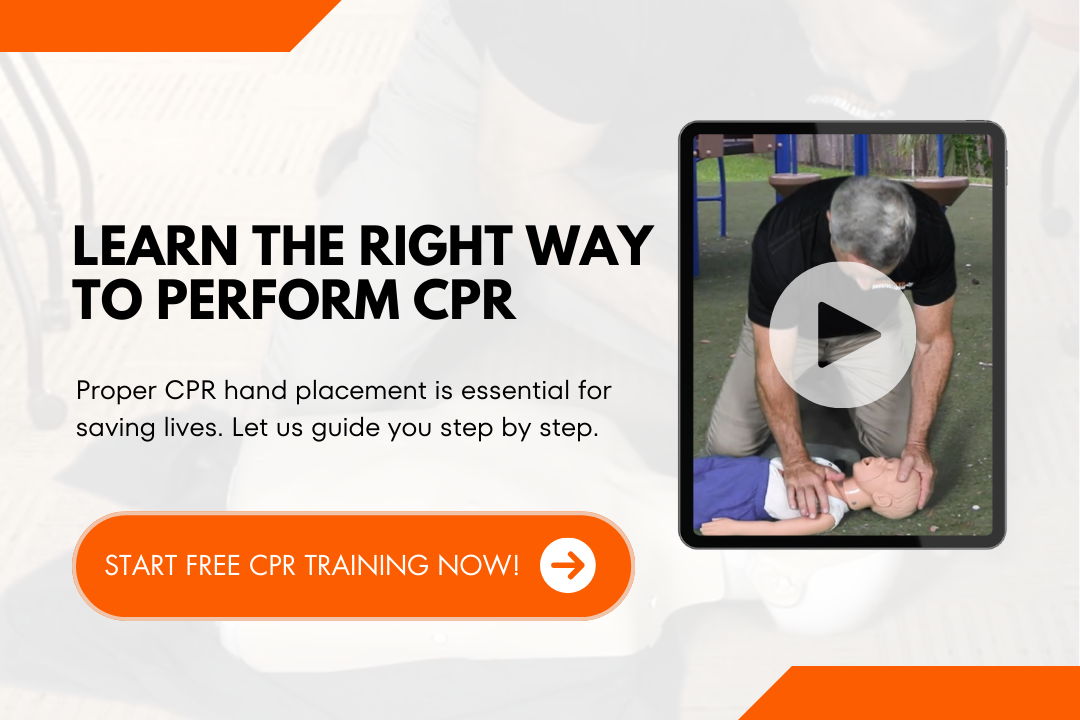
When performing CPR on children, use one hand instead of two. Place the heel of your hand in the same position as with adults, but apply less pressure. Children’s bones are more fragile, so compressions should only go about 1/3 of the chest’s depth. If the child is closer to pre-teen size, you may need to switch to two hands.
Infants:

For infants, use only two or three fingers for compressions, placing them at the center of the chest, just below the nipple line. Since infants are so small, the goal is to compress only 1/3 of the chest depth. Another recommended technique is using your thumbs to press on the chest while your fingers wrap around the back for added support. Avoid using too much force as infants are very delicate.
Become CPR Certified Today!
The best way to ensure you’re ready to save a life is to complete formal CPR training. Luckily, you don’t need to attend an in-person class. With Online CPR Skills, you can start your Free Online CPR Training anytime, from anywhere! Our courses, led by Capt. Wayne Bennett, are OSHA-compliant, AHA® & ECC/ILCOR-aligned, and up-to-date with the latest guidelines. Plus, you pay only $29.95 for a national accreditation certificate valid for 2 years after passing the course. Get certified today and be prepared to act when it matters most.
Take your free CPR course here.
