
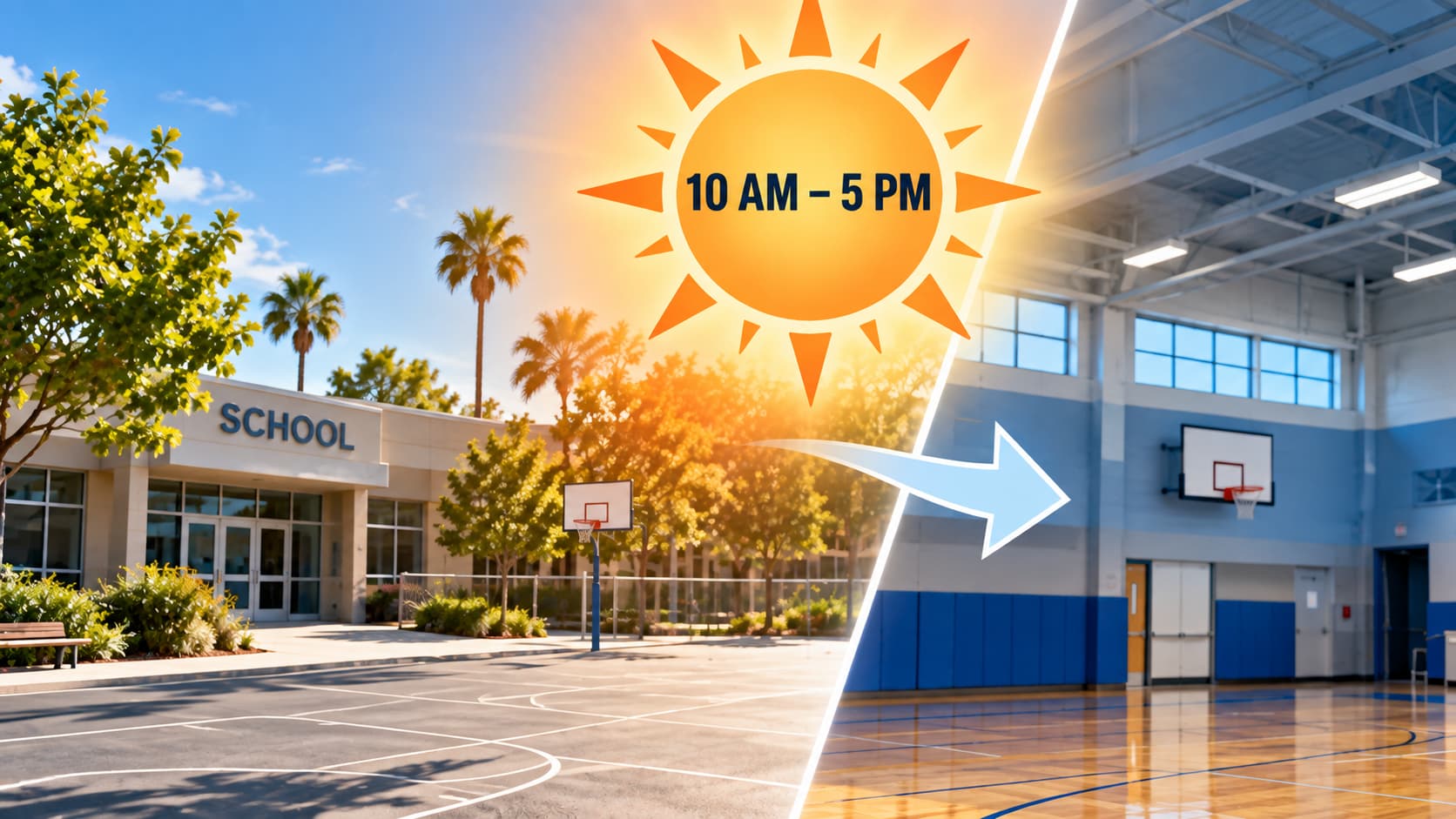
Every California district had to adopt an extreme weather protocol by July 1, 2026. This is the working version for staff: what to check, what to change, and what to do when a student goes down.
Before school: check the forecast
- Check the NWS HeatRisk forecast — a five-level scale, seven days out, built with the CDC.
- Check your district’s extreme weather protocol for the threshold that triggers changes. Education Code #33355 required every district to have one.
- If nobody at your site knows where that document is, fix that first.

Modify the day: 10 a.m. to 5 p.m.
That window does the most damage. When the risk level says modify:
- Move PE, recess and practice indoors, into air conditioning, or into full shade.
- Shorten outdoor blocks. Add breaks instead of pushing through.
- Lower the intensity.
- Shift athletics to early morning or evening.
Hydration and shade
- Schedule water breaks. Send everyone, not just the students who ask.
- Tell them to drink before they feel thirsty. Thirst arrives late.
- Let students carry and refill bottles without permission.
- Position supervision in the shade so students stay there.
- Open cooling rooms and say out loud that students may use them.
What California law already requires
- Schools must allow sun-protective clothing outdoors, including hats.
- Schools must allow sunscreen without a doctor’s note.
- Schools may still set reasonable dress code policies, and staff aren’t required to apply sunscreen for students.
Students at higher risk
Asthma, heart conditions, diabetes, obesity, and medications that affect heat tolerance all raise risk. Check health care plans before the activity, with your school nurse.
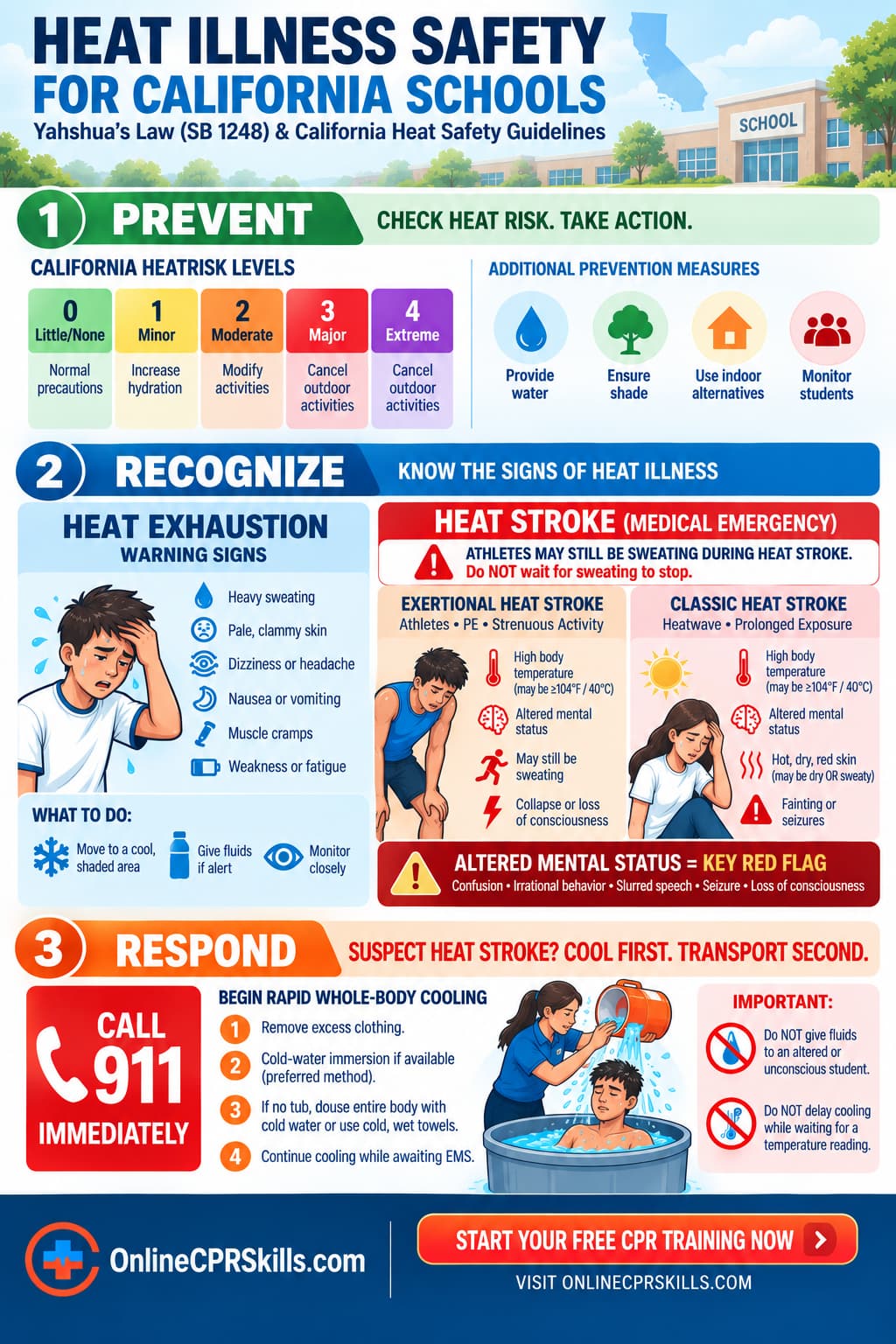
Heat exhaustion: signs and response
Signs: heavy sweating · cool, pale or clammy skin · weakness · dizziness · headache · nausea · muscle cramps · fast, weak pulse.
Do this:
- Move to shade or air conditioning.
- Loosen or remove extra clothing and equipment.
- Cool with wet cloths.
- Offer small sips of water.
- Stay with them.
Get medical help if they vomit, get worse, or aren’t better within an hour. No physical activity for the rest of the day.
Heat stroke: call 911
Call 911 for: confusion · slurred speech · staggering · loss of consciousness. Skin is hot and red, temperature 103°F or higher, pulse fast and strong.
The mistake to avoid: most training says heat stroke means dry skin and no sweating. The CDC says skin may be “hot, red, dry, or damp.” A student who collapses during PE is often still sweating. Don’t wait for sweating to stop.
Behavior change is the sign.
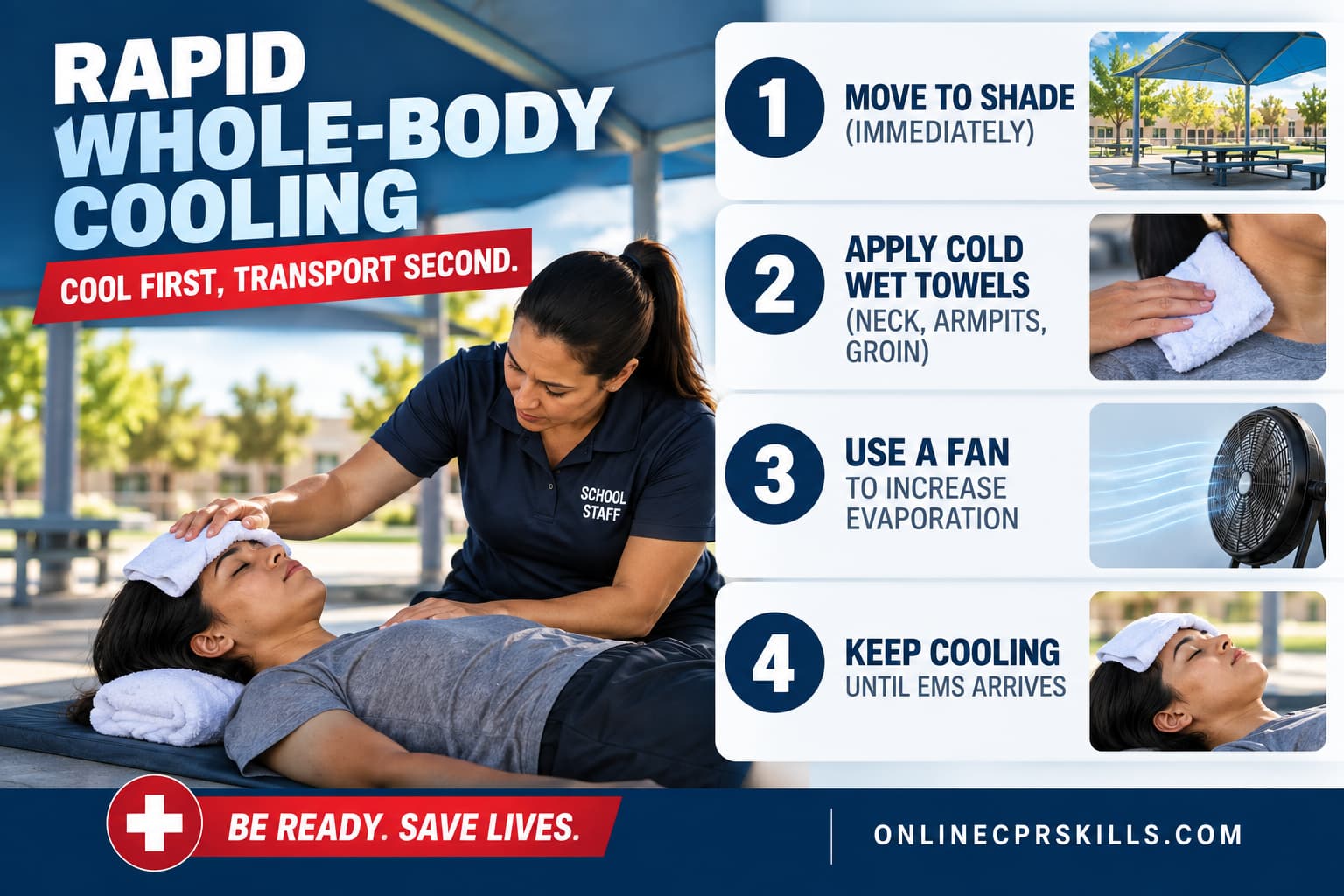
Cool first, transport second
After you call 911:
- Move the student to shade or indoors.
- Rotate cold, wet towels over as much of the body as possible.
- Add cold packs to the neck, armpits and groin.
- Mist the skin and use a fan.
- Give nothing to drink if they’re confused or unconscious.
- Keep cooling until EMS takes over.
Follow your district protocol and school nurse. Whole-body immersion is for trained medical personnel, not school staff.
Train your staff before the next heat wave
Play the video at your next staff meeting, hand out the poster, and confirm two things in the room: where the protocol lives, and who calls 911. For current CPR and first aid skills behind that response, see our training courses.
FAQ
What temperature is too hot for recess? There’s no single national number. The threshold comes from your district’s protocol, which reads a heat risk level, not a thermometer alone. Humidity, sun exposure and acclimatization all change the answer at the same air temperature.
What’s the difference between heat exhaustion and heat stroke? Heat exhaustion: heavy sweat, cool clammy skin, weakness, nausea. Heat stroke: confusion, slurred speech or loss of consciousness. Exhaustion gets shade, cooling and sips of water. Stroke gets 911 and immediate cooling.
When should a school call 911 for heat illness? Any confusion, slurred speech, staggering or loss of consciousness. Also if heat exhaustion worsens, involves vomiting, or hasn’t improved in an hour.
Does California require schools to have a heat protocol? Yes. Under Education Code §33355, the CDE published standardized extreme weather guidelines and districts had to adopt protocols incorporating them by July 1, 2026.
Can students wear hats and use sunscreen at school? Yes, under Education Code §35183.5, without a doctor’s note.
How long does it take students to adjust to a heat wave? One to two weeks of gradually increasing outdoor time and intensity.
General safety training for school staff, not medical advice. Follow your district’s protocol and call 911 for any suspected heat stroke.
