FREE RESOURCE FOR CALIFORNIA SCHOOLS
Heat Illness Training for School Staff
An 8-minute video for teachers, PE staff, coaches, aides and front-office staff. It covers how to prevent heat illness, how to tell heat exhaustion from heat stroke, and what to do in the first 30 minutes of an emergency. Show it at your next staff meeting.
- Free, with no sign-up
- Supports the EC 33355 staff-training requirement
- Printable infographic and staff training record
- Taught by a retired fire captain
Watch: Heat Safety for School Staff
Play it full-screen at a staff meeting, send it to coaches before practice starts, or add it to your new-hire onboarding.
Presented by Capt. Wayne Bennett (Ret.): 33 years as a Southern California firefighter and more than 30 years as an American Heart Association instructor.
Why California schools need this now
Education Code §33355 (SB 1248, “Yahushua’s Law”) required every local educational agency to adopt an extreme weather protocol by July 1, 2026 and to review it every year. Under the California Department of Education guidelines, a protocol has to include:
- Clear criteria for when weather counts as extreme
- Weather monitoring procedures
- How staff, students and families are told about changes
- Indoor alternatives to outdoor activity
- Staff training on recognizing weather-related distress and how to respond
- Coordination with local agencies
This video covers the recognition-and-response part of that training. Use it alongside your district’s own protocol, not in place of it.
Prevent: what every staff member should do
Check the forecast
Every morning, check the NWS HeatRisk forecast and follow your district’s extreme weather protocol.
Change the schedule
When risk is high, move recess, PE and practice indoors, into air conditioning or into full shade during the hottest hours, usually 10 a.m. to 5 p.m.
Schedule water breaks
Make breaks frequent and required. Students should drink before they feel thirsty.
Shade and cooling
Keep supervision in the shade, and make sure students can get to cooling stations and air-conditioned rooms.
Know who’s at higher risk
Students with asthma, heart conditions, diabetes or obesity: review their health plans before they go outside.
Build up slowly
Acclimatization takes 1–2 weeks. Start with shorter, lighter outdoor time at the start of the year or when a heat wave begins.
Under Education Code §35183.5, students may wear hats and sun-protective clothing outdoors and use sunscreen without a doctor’s note.
Recognize: heat exhaustion or heat stroke?
The two need very different responses, so staff have to be able to tell them apart quickly.
HEAT EXHAUSTION
The student is still alert and answers you
- Heavy sweating
- Cool, pale or clammy skin
- Weakness, dizziness, headache
- Nausea or muscle cramps
Respond: Move them to shade or AC, loosen clothing, cool with wet cloths and give small sips of water. Notify the nurse and the parent, and stay with the student. If they vomit, get worse, or aren’t clearly improving within about 30 minutes, get medical evaluation. No more activity that day.
HEAT STROKE: CALL 911
The student’s behavior has changed
- Confusion or acting out of character
- Slurred speech or stumbling
- Passing out
- Skin hot and red, dry or still sweaty
Respond: Call 911 and start cooling on site right away. Cool first, transport second.
Don’t wait for the sweating to stop. A student in heat stroke on a field or blacktop is often still sweating heavily. Watch for a change in behavior instead.
Respond: the 30-minute rule for heat stroke
According to the National Athletic Trainers’ Association, survival from exertional heat stroke has been 100% when core temperature is brought down within 30 minutes of collapse. The 30 minutes start when the student goes down, not when the ambulance arrives.
If you have a tub, tank or kiddie pool
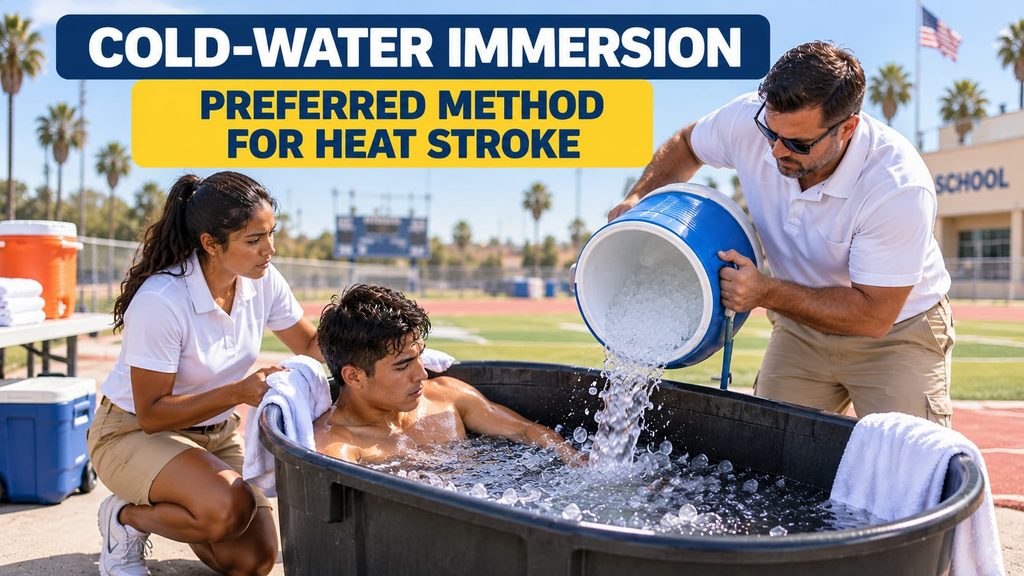
- Call 911 and tell the dispatcher you are starting cold-water immersion.
- Put the student in water up to the neck. The water should be cold (under 60°F), with ice added.
- Protect the airway. One adult stays at the head the whole time and supports the student under the armpits with a towel or sheet across the chest. The head never goes under.
- Stir the water without stopping, and rotate a cold, wet towel over the head and neck.
- Keep cooling until EMS takes over. If EMS hasn’t arrived in about 15 minutes, call the dispatcher back for direction.
Cold-water immersion is for heat stroke only. A student who is alert and talking gets shade, cool cloths and sips of water.
Don’t delay cooling to take a temperature, because oral, ear and forehead thermometers read low after exertion. Never give fluids to a student who is confused or unconscious.
If you don’t have a tub

Tarp method: Lay the student on a tarp. Two adults lift the edges to make a basin, then pour in ice and water and rock it slowly.

No tarp either: Soak the whole body with a hose or shower, and cover as much of the body as you can with cold, wet towels, swapping them every 2–3 minutes.
Ice packs and fans at the neck, armpits and groin help, but they are the slowest option, not the first choice.
FREE DOWNLOAD
Print it. Post it. Share it.
Put the infographic up in the nurse’s office, the PE office, the staff room and the athletic trainer’s kit, so the steps are in front of people when they need them.
The training record is a one-page sign-in sheet you can use to document which staff completed the training.
Administrator checklist: before the next heat day
- Staff know where the district’s extreme weather protocol is kept
- Someone is assigned to check the NWS HeatRisk forecast each morning
- Indoor or shaded alternatives are planned for recess, PE and practice
- Water breaks are scheduled, and students can refill bottles freely
- Nurse has reviewed plans for students at higher risk
- A cooling tub, stock tank or tarp, plus ice, can be reached from fields and gyms
- Staff can explain “cool first, transport second”
- Staff have watched this video, and completion is recorded on the training record
Quick knowledge check
Five questions to check what staff remember after the video. Nothing is recorded.
FOR SCHOOLS, DISTRICTS AND PTAS
Add this training to your school website
If you manage a staff resources, health services, athletics or wellness page, you’re welcome to link to this training. It’s free and there’s no sign-up, and we keep the page current. Copy any of the snippets below.
Good places to link it
- Your district’s extreme weather protocol page
- Health Services or School Nurse page
- Staff resources, onboarding or professional development
- Athletics, PE or coaching resources
- Wellness policy or Safe Schools page
- Staff newsletter, or the PTA or booster club site
Linked to this page from your school site? Let us know and we’ll tell you when the training is updated.
Heat stroke is an emergency. Is your staff ready for others too?
Our online CPR, AED and First Aid training is free to take, and you only pay if you pass and want the 2-year certificate. Most staff finish in under an hour.
More for school staff
Sources
This is general safety training for school staff, not medical advice. Follow your district’s protocol and local EMS direction, and call 911 for any suspected heat stroke.